I grew up believing that caves were the only honest places left on earth.
Rock didn't lie. Darkness didn't pretend. Silence never said one thing and meant another.
There was just one cave that proved me wrong.
It didn't just swallow bodies. It swallowed futures.
I'm Moroccan. My family moved to Florida when I was six. My father fell in with a loose circle of cavers—people who spent their weekends dangling from ropes into holes most folks would walk past without a second glance. Over time, I became one of them.
Helmets, harnesses, descenders, muddy topographic maps pinned to the kitchen wall… that was the background noise of my childhood.
But before I knew the word "exploration," I knew another word much more intimately: "again."
Because the same dream came again. And again.
The Recurring Dream
Always the same.
I'm standing in a narrow cave. The air is thick, like I'm breathing through wet cloth. The walls are so close I can hear my own heartbeat bouncing back at me. In front of me, there's a small opening in the floor—barely big enough for a child to squeeze through.
I wriggle down.
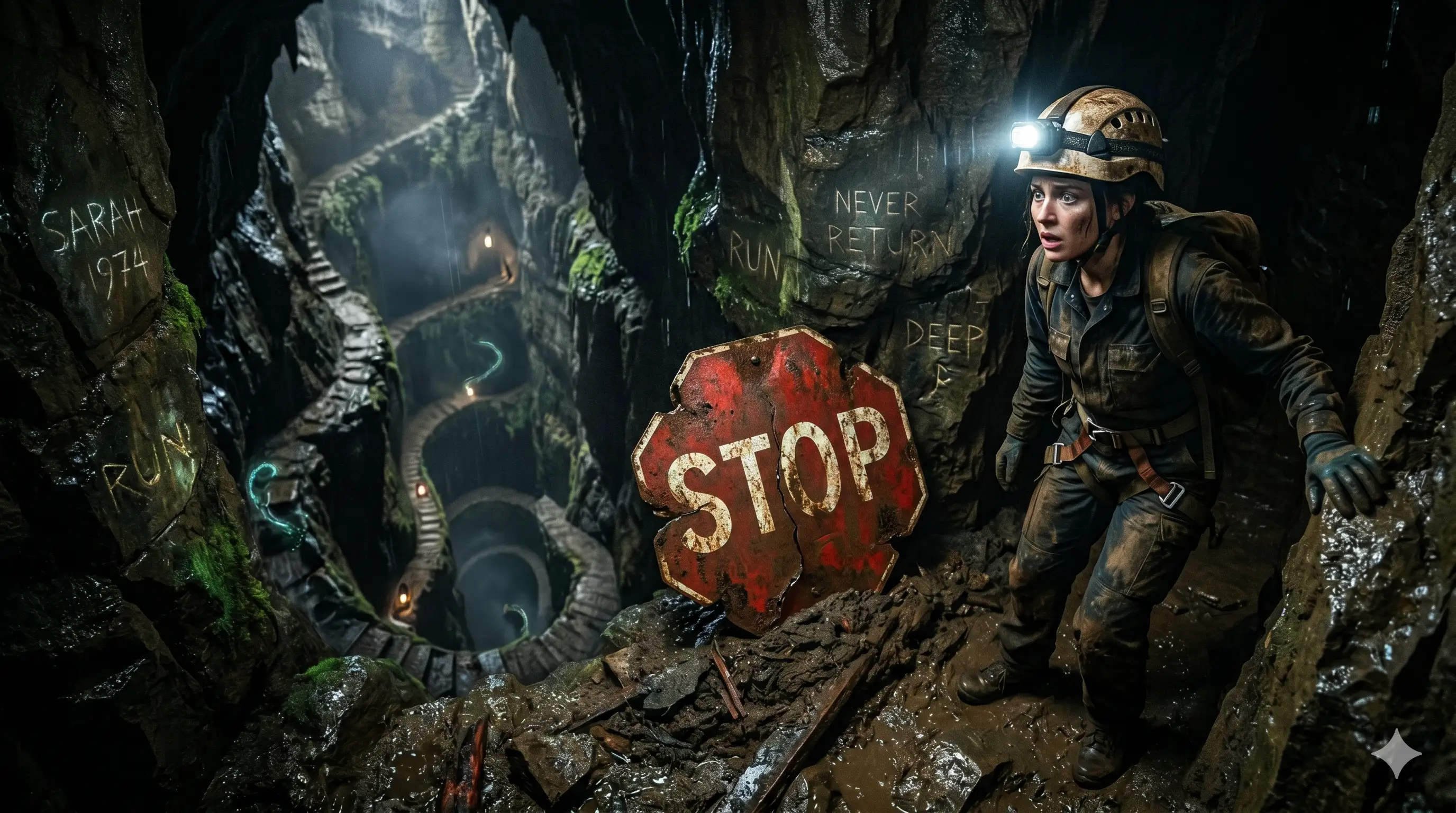
I drop into a short passage, maybe ten or fifteen feet long, only wide enough for one person to hunch and shuffle along. At the end of the passage, it veers left. Right at that bend, there's a red metal shape leaning against the wall—like the bottom half of a STOP sign someone cut in two and threw away down here.
I never ask how a street sign ended up under the earth. In the dream, I just keep walking, knowing the part after the bend isn't meant for me.
After the turn, the floor slopes down and suddenly opens into a vast vertical chamber.
The walls spiral downward, a stone staircase without steps, a corkscrew of rock vanishing into darkness. Instead of neat caver bolts and anchors, there's trash clinging to the walls—crushed cans, a single ruined shoe, shredded cloth plastered in mud.
And at the bottom, there are shapes.
Not quite human. Not quite animal. Just masses of shadow that move too slowly, like they're under thick black water, coiling around something I recognize but refuse to look at directly.
Then the worst part comes: my family is down there.
My father. My mother. My siblings. Each of them is bound to one of those shapes, writhing and twisting. I hear their screams as if they're coming through a drowned phone line, words chewed up by static and distance. I reach, but my arms don't lengthen. I try to shout, but my mouth fills with stone.
And just as those shapes begin to lift their heads toward me—as I feel something rising up the spiral toward where I stand, colliding with my gaze—
I wake up.
Not like waking from a normal nightmare, where you claw your way back into your body.
More like being grabbed by the collar and thrown out of a room you were never invited into.
That dream came two, three times a year. Same cave. Same turn. Same red sign. Same chamber. Same helplessness.
It kept coming until I turned fifteen.
Then it stopped. Completely.
The Blind Drop
Years later, my father said we were heading out to explore a new line of caves in a forest long drive from home.
One of them, he said, didn't have an official name. On the old map they passed around, someone had just circled a small sinkhole and written two words in pencil next to it: Blind Drop.
We reached it near sunset.
The entrance was nothing—just a dark hole in the ground smothered by roots and dead leaves, the sort of place a hunter might lose a dog into and never find it again.
We rigged the ropes. My father tied the first knot. One of his friends rappelled down to check the bottom. We waited for his shout, listening for the echo.
Everything was normal… until I stepped close enough to look in.
Right there, just inside the lip, half-buried in damp soil, was a shard of metal.
It was blackened, rust flirting with the edges, but I could still make out the faint ghost of white letters on red paint.
"STOP."
It was the bottom half of a sign.
And beyond it, cut into the darkness, was a low passage bending left.
Same bend.
Same proportions.
Same feeling that the air was bypassing my lungs and going straight for my heart.
My father called my name from behind me, but it sounded wrong, as if he were speaking from far above a dark sea and I was hearing him from the trench below.
I didn't answer. Something else was talking to me—something I couldn't hear, only feel.
Descent
I clipped in and went over the edge.
The rope under my hands felt colder with every foot I descended, as if invisible stone fingers were running along it with me. When my boots hit the floor of the passage, I knew—I wasn't remembering the dream.
The dream had been remembering this.
– "You good?"
My brother's voice floated down behind me.
"Stay with the rope," I said. My voice came out dry and unfamiliar. "Don't come in here."
I moved forward.
At the end, the passage swung left. The fragment of the sign leaned there, almost whole this time, only its top edge torn away. As if all those years, my dreams had only shown me what would remain after the cave took its due.
I turned.
The passage sloped down, and then there it was—the lip of the vertical chamber.
The same spiraling walls, plunging out of sight. My vision warped as I looked down, like the scene didn't want to sit still on my retinas.
The Names on the Wall
But the walls weren't smeared with trash this time.
They were carved.
Names.
Rows and rows of names scratched into stone; some in English, some in Arabic, some in symbols that bent in directions no alphabet should. I stepped closer to one cluster, reading slowly.
It was my family name.
My father's.
My mother's.
Mine—cut into the rock as if it had been waiting for a blade.
Beneath each name was a date. Some had long since passed.
Some hadn't happened yet.
From the bottom of the shaft, whispers leaked upward.
They weren't in my classmates' American English, or the polished accent of college professors. They were in Moroccan Darija, thick and familiar—but the mouth forming them wasn't human.
"You're late," it said.
The Old Pact
Something slid into my mind then, opening a door I didn't know was there. I saw my grandfather, standing in a lamplit room back in Morocco, speaking quietly with my father. Not about visas or school or money, but about a deal.
A debt.
A life owed somewhere far from home.
A promise that the blood would be paid in a place where no one could find the body, where no imam could pray over the grave.
I realized all at once:
The dream hadn't been a warning. It had been an invitation.
This cave in Florida wasn't a coincidence. It was one mouth of something much older that had bitten into our family generations ago.
"Get out of there!"
My brother's voice came again—but now it was inside my skull, braided with the whispers, impossible to separate.
I grabbed for the rope to climb back up.
My fingers closed on stone.
The rope was gone.
I spun around.
The passage I'd crawled through moments ago had dissolved into shadow. There was no tunnel, no light from above, no way I could point to and say That's where I came from.
Only the carved wall with our names.
Only the spiral path curling down into the dark.
Only the sensation that, with every second I hesitated, some unseen chisel was moving from my name to one of the others.
From my brother's.
From my mother's.
From someone who hadn't done anything except love me.
Another voice rose from below then, wet with dust and years. It sounded like my mother on the night we left Morocco—a sound I'd pretended I couldn't hear through the bedroom door, now stretched and distorted into something not quite hers anymore.
"Don't leave us down here alone…"
The Sacrifice
The shapes at the bottom shifted.
I still couldn't see them clearly, but I understood the logic now. Every step backward would flip a date on the wall from "future" to "past." Every refusal would offer the cave a replacement.
In the end, the choice wasn't noble or brave.
It was just the only way I knew to buy them a little more time.
I stepped onto the spiral and began to walk down.
Years later, people roll their eyes politely when my father tells the story of his son who "disappeared" in a cave.
They say I must have slipped into an unseen crack, gotten wedged in some impossible passage. They tell him bodies get lost underground all the time.
But I know why there's no body to find.
And somewhere far from Florida—maybe in a crowded apartment where a kid falls asleep with his phone in his hand—someone with my blood has started having a new, repeating dream.
A narrow passage.
A red sign snapped in half.
A vertical chamber waiting patiently for a fresh name to carve into its throat of stone.
If that kid wakes up before he turns the corner, he'll have a few more years.
If he doesn't… if he sees the wall, the dates, the empty space beneath his own name—
He'll understand what I did.
And he'll learn, the way I did, that some caves don't end at the limits of the rock.
They end at the limits of what we're willing to give up so the people we love don't have to go first.
— The End —
Comments & Thoughts