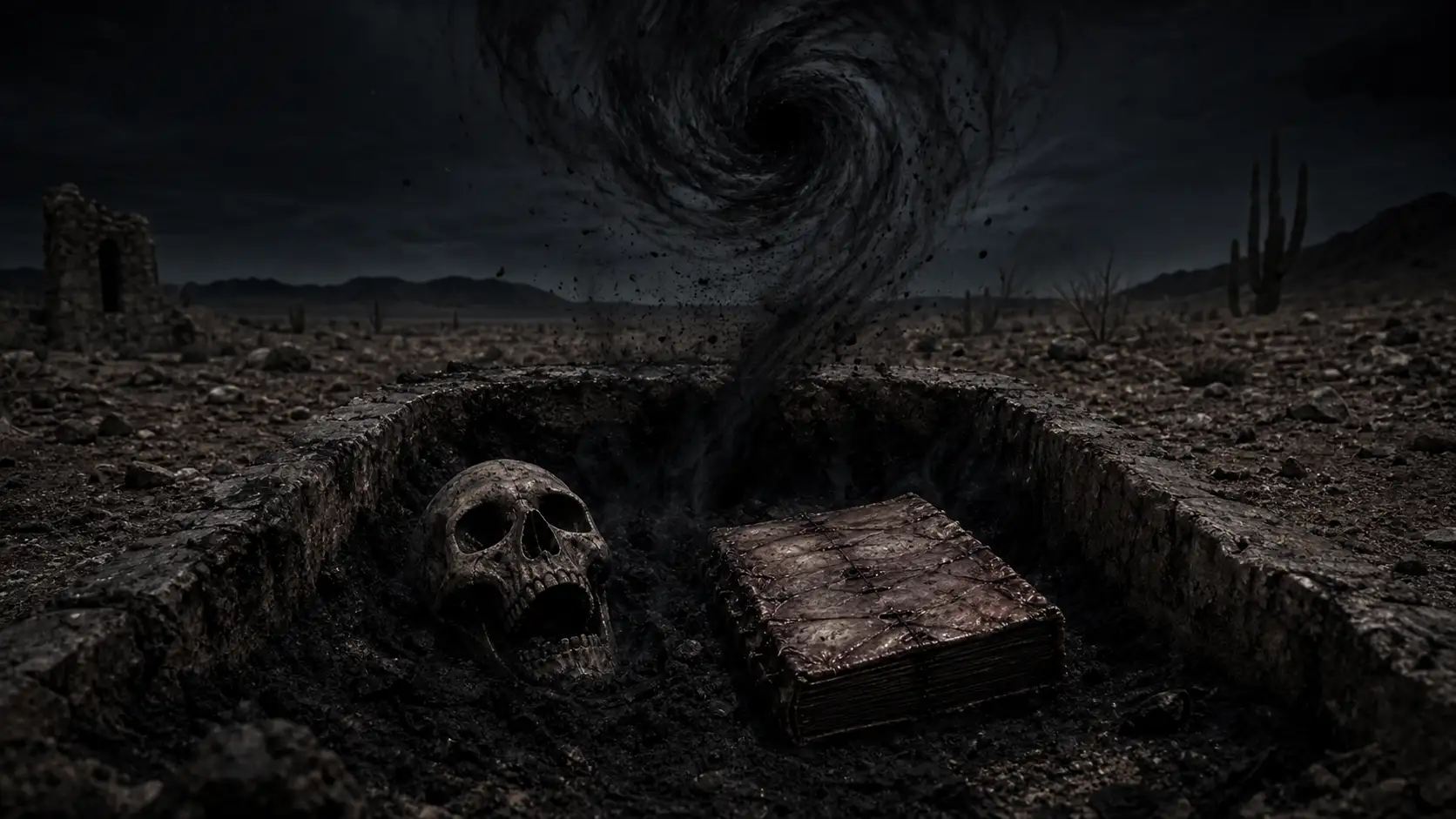
The Expedition Into the Heart of the Desert
My name is Youssef, and I am an archaeology researcher at the University of Rabat. For years I have been studying the ancient petroglyphs scattered across the Moroccan Sahara — those enigmatic symbols left behind by peoples we know almost nothing about. In the spring of 2024, I received a message from my colleague Dr. Idriss informing me that a Bedouin shepherd had stumbled upon an opening in the ground near the Tata region. When the shepherd peered inside, he saw stone steps descending into darkness. He did not go down, but told the tribal elder, who contacted the university.
I assembled a small team: myself; Dr. Idriss, a specialist in ancient languages; Salma, a doctoral student in anthropology; and Hassan, a documentary photographer. We packed our equipment and set off on a two-day drive along rough dirt tracks until we reached the site. The place was utterly barren — nothing but sand and black rocks stretching to the horizon. The silence there was oppressive, not an ordinary silence but one that felt like a living entity watching you.
Descending Into the Forgotten Tomb
We found the opening just as the shepherd had described: a narrow crack between two large boulders, barely wide enough for a single person. When I aimed my torch downward, I saw the stone steps plunging into absolute darkness. The steps were carved with extraordinary precision, and on the walls of the narrow passage were inscriptions unlike anything I had ever seen: depictions of people standing in a circle around a central figure, and above them what appeared to be an open eye gazing downward.
We descended slowly. Each step took us deeper underground, and the air grew heavier and colder with every stride. After roughly fifty steps, the passage opened into a vast chamber. When we switched on our lamps, we all stood frozen in astonishment: the chamber was circular, at least twenty meters in diameter, and at its center lay a deep pit surrounded by a ring of inscribed stone pillars. On the walls, hundreds of symbols were drawn in a dark substance resembling dried blood.
But what truly filled us with dread was what we found at the edge of the central pit: dozens of skeletons arranged in a seated position, each one facing the center, their hands outstretched toward the pit as though offering something — or pleading for something from the depths. Stranger still, their skulls were perfectly intact except for one detail: every skull had a small, circular hole drilled into the forehead, roughly the size of a coin.
The Inscriptions That Should Not Be Read
Dr. Idriss began studying the wall inscriptions. At first he was enthusiastic, snapping photographs and scribbling notes at a feverish pace. But I noticed something began to change in him after about two hours. He fell silent, his eyes fixed on a particular inscription on the northern wall. I asked him: "Idriss, are you alright?" He did not answer. I moved closer and found him trembling, his face bearing an expression I had never seen before — a blend of stupefaction and absolute terror.
He said to me in a shaking voice: "Youssef, these inscriptions are not merely religious or ritualistic writings. They are instructions. Instructions for breaking what they call the Fourth Wall of Consciousness." I asked him what he meant. He said: "According to these inscriptions, whoever built this place believed that human consciousness has four walls, like a room. The first wall is your awareness of yourself; the second, your awareness of others; the third, your awareness of the physical world. But the fourth wall..." He paused and swallowed hard. "The fourth wall is the barrier between your consciousness and whatever is watching you from outside. Whoever breaks this wall sees the truth — but is never the same again."
I looked at the holes in the skulls with a new and terrifying understanding. These were not the result of violence or disease — they were deliberate. The ancient people had drilled into their own foreheads as part of the ritual, as though opening a window in their brains. A cold shiver ran down my spine, even though I am a scientist who does not believe in superstition. But this place made you question everything you thought you knew.
The First Night and the Hallucinations
We set up camp above ground near the entrance. None of us wanted to spend the night below. We ate dinner in near-total silence. Idriss was still withdrawn, drawing the symbols he had seen over and over in his notebook. Salma was reviewing the photos she had taken, and Hassan was cleaning his camera lenses.
Around midnight, I was woken by a sound. It was not an ordinary sound — more like a low-frequency hum rising from beneath the earth, as though the tomb itself were breathing. I stepped out of my tent and found Salma standing near the entrance, staring down into the darkness. I called out: "Salma, what are you doing?" She turned to me and spoke in a voice that did not sound like hers: "Can you hear them? They are speaking. They say we have opened the door and it cannot be closed again."
I grabbed her arm and pulled her away from the opening. She seemed to wake as if from a dream. She asked me: "What happened? Why am I here?" I told her she had been sleepwalking. But deep down, I knew this was not mere sleepwalking. Something was happening to us — something that had started the moment we descended into that chamber.
Day Two: The Truth Reveals Itself
The next morning, we went back down. This time I noticed something I had missed the day before: on the floor surrounding the central pit, channels had been carved with meticulous precision, forming a spiral pattern. All the channels led into the pit. When I dropped a small stone into the pit to estimate its depth, I waited for the sound of impact. I waited. And waited. No sound came. The pit was either impossibly deep, or the sound was being swallowed before it could reach us.
Idriss began acting even more strangely. I found him sitting before the northern wall, reading the inscriptions aloud in a language I had never heard before. The words were alien, emerging from his throat in a way that seemed unnatural, as though someone else were speaking through him. I tried to stop him, but he shoved me away with a force that did not match his thin frame. He looked at me and said: "Do not interrupt me, Youssef. I am on the verge of understanding. The fourth wall is not a metaphor — it is real. We live inside a room, and there is something watching us from outside."
At that moment, something happened that I cannot explain to this day. The air in the chamber changed abruptly, becoming ten times heavier, and I felt an immense pressure on my chest as if something invisible were pressing down on me. The lamps began to flicker. Then I heard a voice — not from Idriss, not from any specific direction, but as though it came from everywhere at once and from inside my own head simultaneously. The voice was repeating a single word I did not understand, but it made every cell in my body tremble.
The Escape and the Price
I screamed at everyone: "Get out! Now!" Salma and Hassan bolted toward the stairs immediately. But Idriss did not move. He was smiling a strange smile, staring into the pit. I had to drag him by force. He resisted and screamed: "Let me go! I can see them! I can see what lies beyond the wall!" But I did not let go. I hoisted him onto my shoulder and climbed the steps one by one while he pounded my back and shouted in that alien language.
When we emerged into the sunlight, Idriss collapsed to the ground and began to weep. Not an ordinary cry, but the weeping of a man who had seen something that shattered his understanding of reality. He wept for a full hour without stopping. When he finally calmed, he looked at me with completely vacant eyes and said: "Youssef, everything we believe to be real is merely the surface. There is something beneath it. Something watching. And they know that we now know."
We packed our belongings and left that same day. We did not wait. We did not take more photographs. We did not return to the tomb. I reported the site to the university but recommended against sending another team without special precautions. Of course, they did not take my warning seriously.
After our return, Idriss was never the same. He left the university and now spends his days drawing the same symbols on papers and on the walls of his apartment. Salma developed chronic insomnia — she says that whenever she closes her eyes she sees the pit and hears the hum. Hassan deleted every photograph he had taken and refuses to speak about the expedition at all.
As for me, something shifted in my perception that I cannot precisely describe. I sometimes feel that someone is watching me — not from behind me or through a window, but from an angle I cannot identify, as though the gaze comes from a dimension that does not obey the three dimensions we know. And in rare moments, when I am alone in the dark and my mind is perfectly still, I hear that faint hum rising from beneath the earth, as though the tomb never truly let me go.
I do not know exactly what we found in that tomb. I do not know whether what Idriss saw was real, or whether the place inflicted some form of collective hallucination on all of us. But I know one thing with absolute certainty: there are things in this world that humankind should not seek out. And some doors, once opened, can never be closed again.
— End of Story —
Comments & Thoughts